

- MCP tools for AI assistants
- Data APIs for programmatic access
- Publisher SDK for embedded analytics
Package Configuration
A package requires apublisher.json file that defines its metadata:
.malloyfiles - Semantic model definitions.malloynbfiles - Malloy notebooks for exploration and documentation- Data files (CSV or Parquet) - Embedded data that gets published with your package (see Embed Data Files)
Curating Discovery
By default, every model is listed and every source is directly queryable. Add optional fields topublisher.json to narrow what agents see.
explores
.malloy file paths (relative to the package root) whose models agents should discover and land on.
- Omit — discovery unchanged; every model and source stays listed.
- Set — listings narrow to these files, plus each file’s
export { … }closure.
queryableSources
Whether non-curated sources can still be queried by name. Only applies when explores is set.
| Value | Listing | Query by name |
|---|---|---|
"declared" (default) | Curated set only | Non-curated sources return 404 |
"all" | Curated set only | All sources still queryable |
export { … }
explores filters which files are listed; export { … } filters which sources within a file are exposed. A file with no export exposes all its top-level sources; add export { orders } to keep imported or scaffolding sources out of discovery.
This curates discovery, not access — what is listed and queryable by name, not who may query. To restrict access by user or group, use
#(authorize) and secure givens.Hiding an #(authorize)-gated source. An access gate blocks querying, not discovery, so a gated source still appears in listings to callers who can’t query it. To hide it while keeping it queryable for authorized callers, leave it out of the curated explores/export set and set queryableSources: "all". Under the default "declared", the non-curated source returns 404 by name — which blocks authorized callers too.Publishing via Cursor Agent
The easiest way to publish is with the/credible-publish skill. Type /credible-publish in the agent chat — the agent will create a publisher.json if needed and run cred publish --set-latest for you.
Publishing via CLI
You can also publish directly with the Credible CLI:-
Install the CLI (if not already installed):
-
Navigate to your package directory:
-
Login to Credible:
-
Set your environment (the CLI subcommand is still named
projectfor backwards compatibility): -
Check the version: Open the
publisher.jsonfile and confirm the version number -
Publish the model:
The
--set-latestflag pins this version as the default “latest” version for consumers. Omit this flag to publish without pinning. - Confirm the deployment: Refresh the “Credible Service” panel in Cursor to verify that your new version appears
Want to automate publishing when changes are merged to Git? See CI/CD Setup to configure GitHub Actions for automatic versioning and publishing.
Understanding Package Versions
Each time you publish a package, you create a new immutable version. All versions remain available indefinitely, providing full version history and lifecycle management similar to software packages.Version Management
Pinned Version (Latest): One version can be designated as “latest” - this becomes the default version served to consumers who don’t specify a version. Consumers using “latest” automatically receive updates when you change the pin, unless they explicitly pin their application to a specific version (such as a dashboard that should remain stable). All Versions Remain Available: Every published version is preserved, enabling rollbacks, pinned production deployments, gradual adoption across teams, and historical audits. This version management approach treats semantic models as versioned software artifacts, giving you the same deployment safety and flexibility that modern software engineering practices provide.Viewing Published Versions
After publishing, you can view your package versions in two places:- Credible Service Panel in Cursor — expand the panel to see your published packages, all versions, and which version is pinned as latest
- Credible App at
https://your-org.app.credibledata.com— navigate to your environment and click on a package to see complete version history, pin/unpin versions, and view package metadata
Indexing
After publishing, the Credible Context Engine indexes your model’s dimensions, measures, views,#(doc) descriptions, and #(index) dimensional values. This indexing is what makes your model ready for consumption — whether through workspace chat, LLMs connected via MCP, custom agents, or any other consumer of the Credible platform.
Indexing typically takes around 10 minutes. You can check the status on your environment page or package page in the Credible App (https://your-org.app.credibledata.com) — look for a green “Indexed” tag on the package.
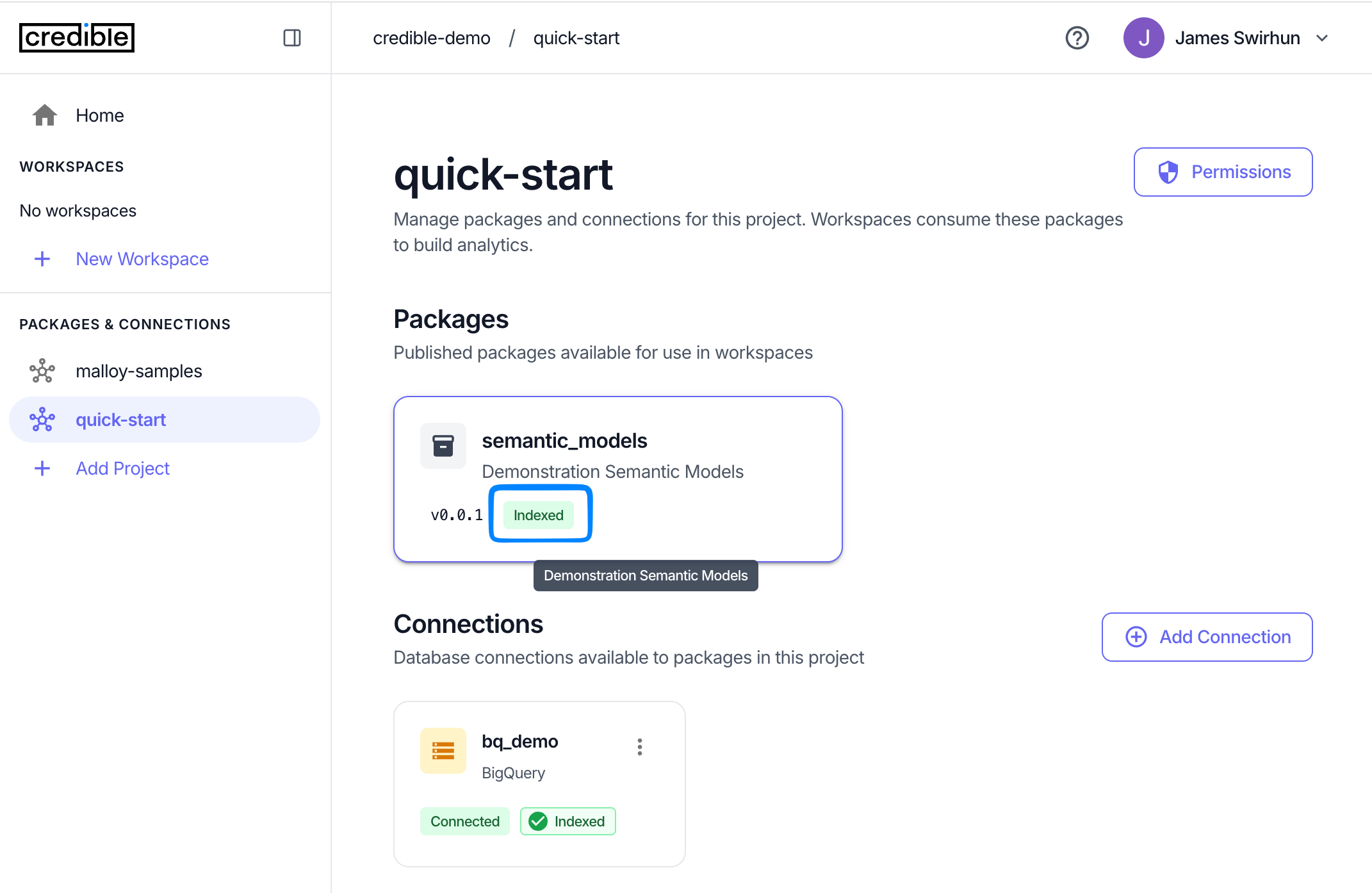
Until indexing completes,
get_context calls will not return results for the new version. The execute_query tool and Data API are available immediately after publishing.Next Steps
Now that you’ve published your models, you can analyze your data or build applications with your data.Analyze Data
Use the Data Explorer and AI agents to analyze your published models
Build with Data
Build applications and embed analytics using your published models